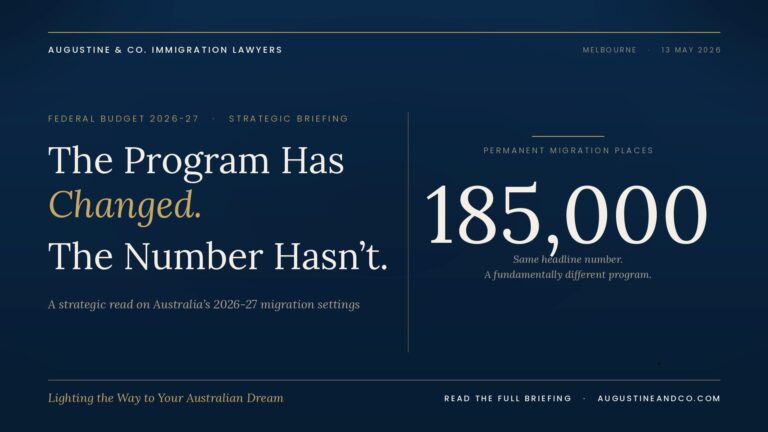
The 2026–27 Federal Budget has delivered the clearest signal yet that Australia’s migration program is entering a new phase — one defined by a tighter cap on net overseas migration, a decisive tilt toward onshore applicants, an “optimised” Points Test that will reward youth and higher skill, and an expanded character regime that places more existing visa holders within reach of refusal or cancellation.
For prospective migrants, current visa holders, and the Australian businesses that depend on overseas talent, the implications are immediate. This briefing distils the most consequential migration measures in the 2026–27 Budget — and, just as importantly, translates each into the strategic decisions you may need to make in the weeks ahead. For tailored advice on your position, our leading Australian immigration lawyers can help you act ahead of the regulatory changes coming into force.
1. The Migration Program Holds at 185,000 — But the Geography of Allocation Has Shifted
The 2026–27 permanent Migration Program planning level remains at 185,000 places, with the long-standing 70% Skilled / 30% Family split preserved.
The headline figure, however, obscures the more significant change. The Government will allocate 129,590 places — 70% of the program — to migrants already living in Australia. Only 55,110 places are reserved for offshore applicants, and those will be channelled predominantly toward highly skilled candidates whose qualifications respond to Australia’s long-term skill needs. Net overseas migration is forecast to fall to 245,000 in 2026–27 and to 225,000 in 2027–28.
Strategic implication. For applicants outside Australia, the offshore queue is narrowing in absolute terms. Onshore visa holders — including those on a Subclass 482 Skills in Demand visa, a Subclass 485 Temporary Graduate visa, or another substantive temporary visa — are in a materially stronger structural position than they were twelve months ago. The question for many onshore candidates is no longer whether to pursue permanent residency, but which pathway best matches their occupation, age, and English profile under the settings now coming into force.
2. The Points Test Is Being “Optimised” — and the Bar Will Rise
Beneath the headline figures sits a short but potentially far-reaching commitment: the permanent migration Points Test will be optimised to better select more highly educated, higher-skilled, and younger migrants, who the Government says drive productivity and long-term prosperity. Currently, almost two-thirds of permanent skilled migrants are selected through points-tested visas.
The Government has not yet released detailed parameters. What is clear is the direction of travel. Future Subclass 189 (Skilled Independent), Subclass 190 (Skilled Nominated), and Subclass 491 (Skilled Work Regional) applicants should expect a points framework that rewards advanced qualifications, demonstrably higher skill levels, and lower age more heavily than the current settings.
Strategic implication. Applicants in the points-tested pipeline — particularly those approaching the upper age thresholds, those relying on current allocations for English proficiency or work experience, or those whose Expressions of Interest (EOIs) have not yet attracted an invitation — should review their position now. Submitting an EOI under current settings, accelerating an English test attempt, or finalising a skills assessment before the new framework takes effect may materially change a candidate’s prospects.
3. Skills Assessment and Trades Recognition: $85.2 Million for a Modernised Pathway
The Government will invest $85.2 million to accelerate skills assessments and occupational licensing for migrant trades workers, targeting an additional 4,000 skilled trades workers entering the Australian workforce each year. The major components are:
- $75.1 million over four years to deliver a modernised assessment system at Trades Recognition Australia (TRA), including pilots with states and territories on streamlined assessment-to-licensing pathways for priority trades such as electricians and plumbers.
- $5.6 million over three years for a new program of skills assessments for onshore visa holders, designed to better recognise the qualifications and practical trade experience they already hold.
- $4.5 million to strengthen regulatory oversight of Assessing Authorities, including a requirement for every Assessing Authority to publish an annual Performance Report from 2027.
In parallel, a National Credit Recognition Framework developed by the Australian Tertiary Education Commission will reduce unnecessary repetition in study for university students who hold relevant VET qualifications. The Department of Employment and Workplace Relations will also consult on requirements for a skills migration commissioner.
Strategic implication. Trades workers and employers across the construction, electrical, and plumbing sectors should anticipate a faster but more transparent pipeline from assessment through to licensing. For applicants who have stalled at the skills assessment stage, the onshore reforms in particular may open a viable route forward. Speak with our team to assess your timing.
4. The Character Regime Expands: New Visa Refusal and Cancellation Grounds
One of the most legally significant developments in this Budget relates to character. The Department of Home Affairs has been funded to implement the migration elements of the Combatting Antisemitism, Hate and Extremism (Criminal and Migration Laws) Act 2026, introducing new visa refusal and cancellation grounds and new character test provisions under the Migration Act 1958.
The Budget also funds a prohibited hate group listing framework administered jointly by the Department of Home Affairs and the Attorney-General’s Department, together with additional training for visa officers. A further allocation supports the Commonwealth Community Safety Order Scheme, through which the Minister for Immigration may apply for supervision or detention orders against certain non-citizens deemed to pose a risk of harm to the community.
Strategic implication. The character regime — historically one of the highest-stakes areas of Australian migration law — is widening. Existing visa holders now face pathways to refusal and cancellation that did not exist when their visas were granted. Where a visa holder has any history of association, conduct, or online activity that could conceivably engage the new grounds, the position warrants urgent and confidential review with experienced immigration counsel. A visa cancellation under the expanded framework is not a paperwork problem; it is a life-altering event with procedural consequences that closely resemble those of the criminal law. Contact our immigration lawyers for a confidential review.
5. Protection Visas: A New Pilot Signals Tightening at the Judicial Review Gateway
The Government will fund a $3.9 million pilot — “Addressing Misuse of the Protection Visa System” — to provide pre-filing legal assistance in migration matters before the Federal Circuit and Family Court of Australia. The stated aim is to help prospective judicial review applicants make informed, merit-based decisions about whether to file a protection claim.
The framing — “addressing misuse” — is itself revealing of the Government’s view of current protection-related filings.
Strategic implication. Protection visa applicants and those considering judicial review of an Administrative Review Tribunal (ART) decision should be aware that the strategic environment around protection-related litigation is shifting. Sound legal advice at the point of filing — including a candid view on prospects of success — will be more important, not less. Our immigration lawyers and migration consultants can help you assess your position before you file.
6. Working Holiday Maker Program: Ballots Expand, Settings Tighten
The Government has confirmed that the Working Holiday Maker (WHM) program will be reformed, with expanded use of ballots designed to better control numbers, reduce barriers to work, provide a fairer allocation across source countries, and support Australia’s national interests.
Strategic implication. Prospective Subclass 417 (Working Holiday) and Subclass 462 (Work and Holiday) applicants from ballot countries should expect a more competitive and time-sensitive allocation process. Employers in agriculture, hospitality, and tourism that rely on WHM workers should be planning workforce continuity strategies that do not assume uninterrupted supply.
7. Border Force, English Language Program, and Protections for Vulnerable Migrants
Several further measures round out the migration picture:
- Australian Border Force receives $270 million in supplementary funding for 2026–27.
- The Adult Migrant English Program will move to a new model from 1 January 2029, with revised eligibility settings and flexible tuition designed to target clients most in need of formal English tuition.
- The Support for Trafficked People Program Additional Referral Pathway has been extended to 30 June 2027, allowing victim-survivors of human trafficking and modern slavery to access case-managed support — including legal and migration advice — without needing to engage law enforcement.
- A $27 million extension of the Protecting Migrant Workers — Information and Education Program will fund activities to better protect migrant workers from exploitation.
What This Budget Tells Us — and What to Do About It
Read together, the migration measures in the 2026–27 Federal Budget describe a program that is becoming smaller in flow, sharper in selection, tougher in character review, and decisively weighted toward onshore applicants and high-skilled offshore candidates. The 185,000 permanent planning level is the same number it was a year ago; the program it funds is not.
For each cohort, the strategic response is different:
- Onshore temporary visa holders are in the strongest structural position in years to convert to permanent residency, but should not assume that current eligibility thresholds will remain available indefinitely. If you are on a Subclass 482 Skills in Demand visa, now is the time to assess your 186 pathway.
- Offshore skilled applicants — particularly those in points-tested categories — should consider the timing of their EOI, skills assessment, and English testing carefully. Subclass 491 holders already onshore are well-positioned and should act before the new Points Test parameters are locked in.
- Sponsoring employers should map workforce continuity against a tightening offshore allocation and the WHM ballot reforms.
- Existing visa holders with any character-sensitive history should obtain confidential advice on their exposure under the new refusal and cancellation grounds before — not after — any departmental engagement.
- Trades workers and licensing applicants should plan to take advantage of the modernised TRA assessment pathway as it rolls out.
The window for strategic action is narrow. Many of these measures will be implemented through legislative instruments, regulations, or operational policy in the coming months — and the strongest applications are almost always those prepared before a regulatory change takes effect, not after.
Speak With an Immigration Lawyer Who Reads the Budget Papers
Speak With an Immigration Lawyer Who Reads the Budget Papers
At Augustine & Co. Immigration Lawyers — Australia’s immigration law specialists — we read the Budget Papers and the legislative instruments so our clients don’t have to, and we translate Commonwealth migration policy into clear, actionable advice tailored to each client’s circumstances.
Whether you are a skilled professional weighing the timing of your permanent residency application, an Australian business sponsoring overseas talent, or a visa holder concerned about your exposure under the expanded character regime, we can help you respond to the new settings with confidence.
Our Melbourne-based immigration lawyers advise clients across Australia and offshore — in person at our Lonsdale Street chambers or by secure video consultation.
To discuss your position with our team, call +61 3 7020 6514 or book a confidential consultation.
Augustine & Co. Immigration Lawyers | Level 11, 456 Lonsdale Street, Melbourne VIC 3000 | Lighting the Way to Your Australian Dream
This article reflects measures announced in the 2026–27 Federal Budget. It is general information only and does not constitute legal advice. Migration law changes frequently and outcomes depend on individual circumstances. For advice tailored to your position, please contact Augustine & Co. Immigration Lawyers.
Author

Calvin Augustine is the founding solicitor of Augustine & Co. Immigration Lawyers. He graduated with Honors from the University of London law school, before being admitted to practice in Malaysia and Australia (admitted in SA, appears in all Victorian Courts and Tribunals, at trial and appellate levels).